Reviewed by: Academic Head, Health Information Management, Luminis Institute
Published: August 2026
Last updated: August 2026
Somewhere between the Plus Two result and the family WhatsApp group blowing up with “so what next?”, a lot of students quietly panic. MBBS didn’t happen. NEET didn’t go the way it was supposed to. And suddenly, healthcare feels like a door that just closed.
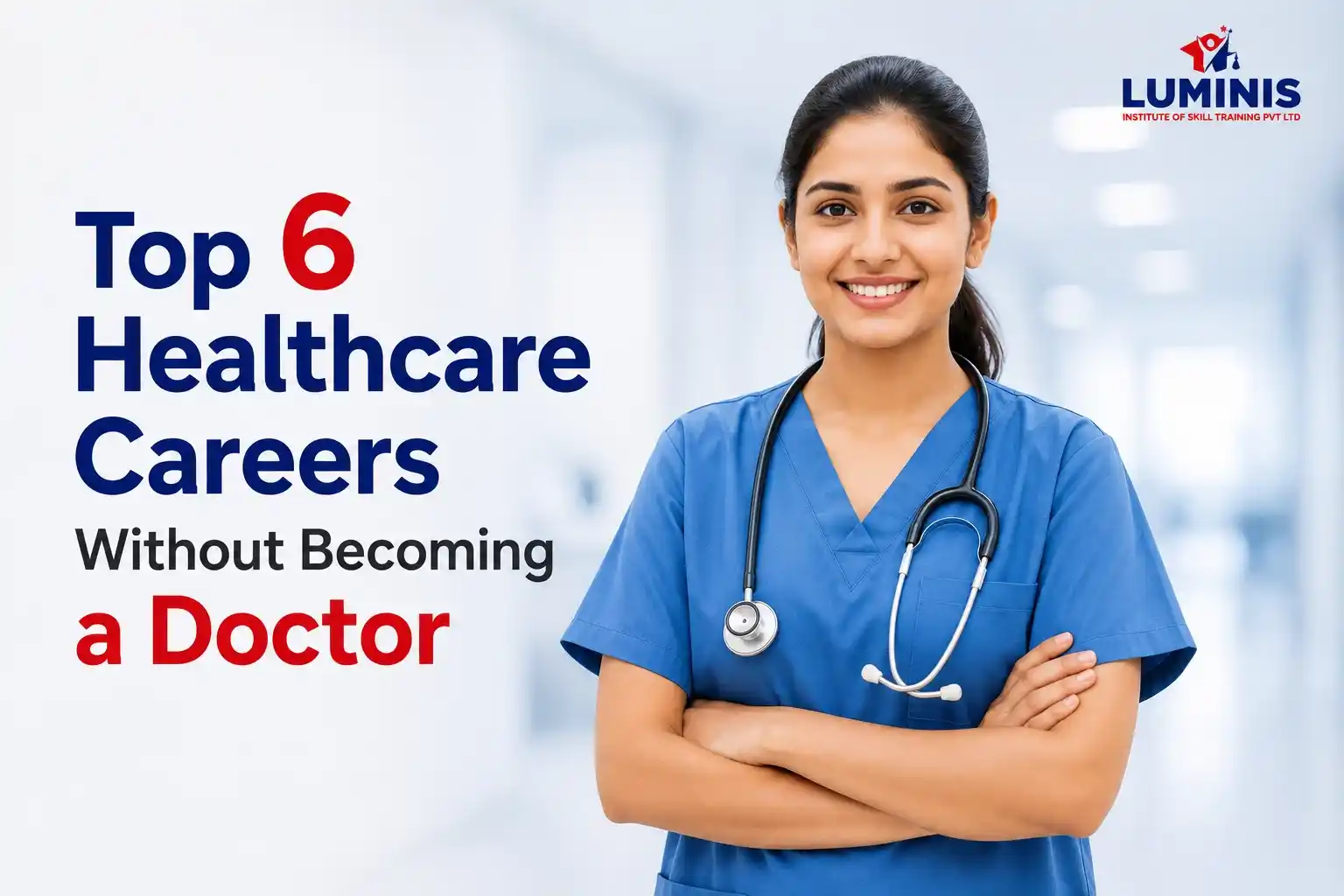
It didn’t. It just has more rooms than the one everyone points to first: Careers in Healthcare Without Becoming a Doctor.
Hospitals, diagnostic labs, insurance firms, health-tech startups, and even international healthcare companies run on hundreds of roles that have nothing to do with a stethoscope. Someone has to manage patient records, process insurance claims, run hospital operations, translate clinical notes into billing codes, and keep entire departments functioning. None of these people are doctors. All of them are in healthcare.
If MBBS was never the plan, or NEET didn’t work out this year, here’s an honest look at what else exists – and why some of it might suit you better than clinical practice ever would.
Why “Non-Clinical” Doesn’t Mean “Less Important”
There’s a quiet assumption that if you’re not treating patients directly, you’re doing something secondary. That’s outdated thinking, and the healthcare industry has moved past it.
A hospital can’t function without someone managing bed occupancy, discharge summaries, and department budgets. An insurance claim can’t be processed without someone trained to read medical documentation accurately. A patient’s entire treatment history exists as data that needs to be organised, coded, and protected. These aren’t backstage tasks. They’re the systems that let doctors focus on medicine instead of paperwork.
Non-clinical healthcare careers are how the industry actually runs at scale. And demand for people trained in these areas is growing faster than most students realise.
Do non-clinical healthcare jobs pay well?
Yes, roles in health information management, hospital administration, and medical coding often come with structured salary growth, especially with international certification, since global healthcare providers outsource this work extensively.
The Career Paths Worth Knowing About
1. Health Information Management
This is the backbone of modern healthcare data. Every diagnosis, treatment, and procedure generates a record, and someone needs to manage that record accurately – for legal compliance, insurance, and patient continuity. Health information management jobs range from data analysts to compliance officers to health record administrators, and the field is expanding as hospitals digitise faster than they can hire.
2. Medical Coding
Medical coding translates a doctor’s diagnosis and treatment into standardised codes used for billing and insurance. It sounds technical, and it is, but it’s learnable without a medical degree. It’s also one of the most globally in-demand skills right now, since US and Gulf healthcare systems rely heavily on outsourced coding talent.
3. Medical Scribing
A medical scribe works alongside a physician during consultations, documenting the visit in real time so the doctor can focus entirely on the patient. It’s one of the fastest ways to get inside a clinical environment without being the one making medical decisions – and it’s often a stepping stone for students still deciding their long-term direction.
4. Hospital Management Careers
Someone has to run the business side of a hospital – staffing, budgets, patient flow, procurement, quality standards. Hospital management careers sit at the intersection of healthcare and administration, and hospitals consistently need people who understand both.
5. Allied Health Career Options
Allied health career options cover a wide field – health information technicians, medical billing specialists, healthcare data analysts, and quality auditors, among others. These are the roles that keep a hospital’s operational and clinical sides connected, and most don’t require years of clinical training to enter.
6. Health Insurance and Claims Processing
Every hospital visit eventually becomes a claim. Someone reviews it, verifies it, and approves or rejects it. This role sits at the intersection of healthcare knowledge and finance, and it’s a career path most students don’t even know exists until they’re deep into researching alternatives.
Can I switch into these careers later, even from a non-science background?
Most of these paths are open to students from any Plus Two stream. What matters more is training in medical terminology, documentation, and healthcare systems – which structured courses are designed to build from scratch.
Talk to a Luminis Career Counsellor
What Actually Gets You Hired
Interest alone doesn’t open these doors. Employers in this space look for three things: understanding of medical terminology, accuracy in documentation, and familiarity with healthcare compliance standards. That’s exactly what dedicated healthcare courses after Plus Two are built around – short, focused, and designed to get graduates job-ready faster than a conventional degree would.
One programme worth knowing about is the BVoc Health Information Management, a course that combines classroom learning with practical exposure to hospital data systems, medical documentation, and health record compliance. It’s structured specifically for students who want a serious healthcare career without spending years on a clinical degree – and it opens doors into hospitals, insurance companies, BPOs, and health-tech firms alike.
Explore Non-clinical Healthcare Courses
Healthcare Careers in Kerala: A Local Advantage
Kerala’s healthcare sector is one of the most developed in India, with a dense network of hospitals, diagnostic centres, and medical BPOs that constantly need trained non-clinical staff. Healthcare careers in Kerala aren’t limited to the state either – many graduates go on to work with hospitals and health systems across the Gulf, given how closely Kerala’s healthcare training aligns with international standards.
For students based in or around Kochi specifically, this matters even more. Allied health courses in Kochi give you access to hospital tie-ups, internship networks, and placement pipelines that are harder to find elsewhere in the state, simply because the city hosts such a concentration of hospitals and healthcare businesses.
Is Kochi a good place to start a healthcare career?
Yes. Its mix of multi-specialty hospitals, insurance companies, and healthcare BPOs makes it one of the strongest cities in Kerala for non-clinical healthcare training and placement.
Check your Eligibility for Healthcare Programmes
So, Where Does This Leave You?
If the plan was always MBBS and that door didn’t open this year, it’s worth pausing before assuming healthcare isn’t for you anymore. The industry needs people who can manage its data, its operations, its documentation, and its compliance just as much as it needs people who can treat patients. Often, it needs them more urgently.
The real question isn’t whether you can still work in healthcare. It’s which part of it actually fits how you think, work, and want to grow.
This is exactly the gap Luminis was built to close – training students for the non-clinical side of healthcare through the BVoc in Health Information Management, with hands-on exposure and placement support that turns a Plus Two result into an actual career, not just a consolation plan.
Explore the BVoc Health Information Management programme at Luminis and find out where you actually fit.